$ eat.paris --initOK
> loading archive16 ADDRESSES
> marchés verified5
> maisons du temps4
> écailler documentedOK
> cave loadedOK
> rituels documented8
> heures mapped5
> checking permanence indexSTABLE
> la maison demeure
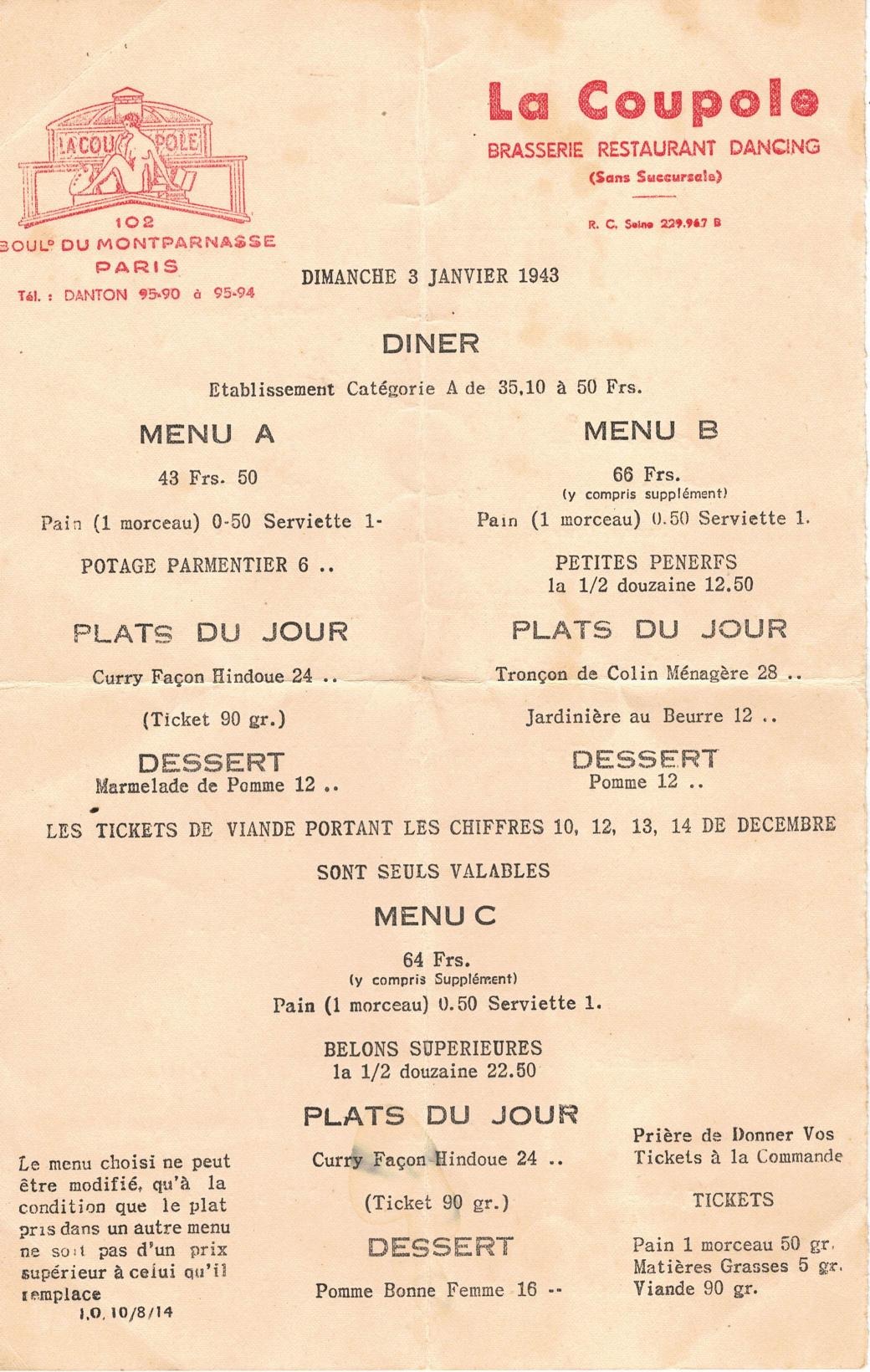
La Coupole, c. 1938
© EAT.PARIS — ARCHIVE PRIVÉE — REPRODUCTION INTERDITE
Eat.Paris is a house.
It holds a position. It records selectively.
What remains matters. What passes does not.
La maison demeure.
ENTER THE ARCHIVE
EAT.PARIS
La maison demeure.
1938
BOULEVARD DU MONTPARNASSE
Doctrine de sélection

An address enters this house when three conditions are met: it has endured across at least two generations of clientele. It has not needed to reinvent itself to remain relevant. And it possesses a gesture, a space, or a ritual that no one else can claim.

An address leaves this house when it ceases to recognise itself. Quand elle ne se reconnaît plus.

À mon père Richard, ma mère Laure,
mes grands-parents : Léonard et sa femme Assanatou,
Jean Francisco et sa femme Anna,
ainsi que mes arrière-grands-parents paternels et maternels.
Address · 16 lieux

← Previous Next →
Maisons du Temps
Four houses whose relationship to time — and to Paris — is not commercial but structural. Quatre maisons pour qui l'horlogerie n'est pas un produit mais une position.
Breguet
Paris since 1775 · Place Vendôme museum

Abraham-Louis Breguet established his workshop on the Quai de l'Horloge in 1775 — the street name itself a premonition. He sold watches to Marie-Antoinette, to Napoleon, to the Ottoman fleet. Le tourbillon, la sonnerie, le spiral Breguet : ce vocabulaire technique est français avant d'être suisse.

The museum at Place Vendôme — the house's contemporary address — is the only horological museum within Paris proper. It does not try to compete with Geneva or the Vallée de Joux. It does not need to. Breguet's claim is older and more specific: this is where the conversation began.

Breguet n'a pas une relation avec Paris. Breguet is a Parisian fact — like the Pont-Neuf, like the Opéra, like the Deux Magots. The city carries the watchmaker's name in its stones.

Cartier
Rue de la Paix since 1899

Cartier is the only maison whose watches are inseparable from the city itself. La Santos was born in Paris for a Brazilian aviator who had made the city his own (1904). La Tank was drawn in Paris, its form derived from the geometry of Renault tanks seen from above (1917). No other house has produced timepieces that carry the DNA of the city in their form.

L'horlogerie de Cartier n'est pas une extension de sa joaillerie. C'est une discipline parallèle — structurée autour de la géométrie plutôt que de la complication. The square, the rectangle, the Roman numeral: Cartier understood that time can be told architecturally.

The history is known: for decades, Cartier did not manufacture its own movements. It sourced, it assembled, it signed. Since 2010, the Manufacture de la Chaux-de-Fonds has changed the equation — Cartier now produces its own calibres. But the earlier truth persists in the DNA: ce qui fait un Cartier, ce n'est pas le calibre — c'est la ligne. And the line was always Parisian.

Tiffany & Co.
New York since 1837

Tiffany understood something before anyone else: that the authority to choose is rarer than the ability to make. While the great manufactures perfected complications in Geneva and the Vallée de Joux, Tiffany built the most powerful editorial filter in American horology. A Patek Philippe bearing the Tiffany stamp on its dial does not carry two names. It carries a double authority — Geneva's mastery endorsed by New York's eye. Un pouvoir que personne d'autre n'a jamais obtenu.

The Nautilus Tiffany Blue of 2021 was not a collaboration. It was a demonstration. 170 pieces. $6.5 million at auction for a single watch. No technical innovation, no new movement, no complication — only a colour and a name. It proved that Tiffany's signature can transform an object's status as decisively as the hand that built it. Le bleu Tiffany est devenu, en une édition, le plus puissant argument culturel de l'horlogerie contemporaine.

À Paris, Tiffany holds a singular position among the great houses: it does not compete on manufacture. It presides over taste. The house that taught America what beauty looks like now occupies the same territory in horology — not the workshop, but the standard. Ce n'est pas une limite. C'est un privilège que seule l'ancienneté confère.

Patek Philippe
Geneva since 1839

Patek Philippe est genevois. La précision l'exige : this is not a Parisian house. But the relationship with Paris is older than most Parisian institutions. The Nautilus (1976), drawn by Gérald Genta — the same hand that drew the Royal Oak — was designed for a world that moves between Geneva, Paris, and New York. Paris was always in the equation.

The Salon at Place Vendôme is not a boutique. It is an appointment. On n'y entre pas — on y est reçu. This distinction is Parisian by nature: the architecture of access matters more than the architecture of display.

The weakness: Patek's relationship to Paris remains that of a visitor, however distinguished. Geneva holds the manufacture, the museum, the archive. Paris holds the client. C'est une relation de respect mutuel — pas de propriété.

Maisons du Temps is an independent editorial section. No house reviewed here has commissioned, sponsored, or approved its entry. Les évaluations sont les nôtres. The method is criticism, not promotion.
Marché
Rungis
Since 1969. Héritier des Halles de Baltard.
The largest fresh market in the world operates before Paris wakes. Ce que la ville mange passe par ici d'abord.
Rue Montorgueil
La dernière rue de marché du centre de Paris. A living remnant of Les Halles — not preserved, not restored, simply still there. La rue a survécu au quartier qui lui donnait son sens.
Marché d'Aligre
Le marché le plus populaire de Paris, au sens premier du mot. Not gentrified. Not curated. Not discovered. Le dernier marché qui ressemble à ce qu'un marché parisien a toujours été.
Marché des Enfants Rouges
Since 1615. Quatre siècles sous le même toit.
The oldest covered market in Paris. Tout a changé autour. Lui, non.
Marché Président-Wilson
En plein air, entre Trocadéro et Alma. Joël Thiébault's vegetables — the finest produce in France, laid out on a pavement. This is where the great tables come before they set theirs.
Écailler
The last artisan who works in the street, in full view, with a knife. Le dernier métier de bouche qui s'exerce sur le trottoir. In Paris, the écailler is not behind the kitchen door — he is the first thing you see.
The Craft
The écailler stands outside, winter and summer, before an étalage of crushed ice. He opens oysters with a short blade, by the hundred, without looking down. The gesture is fast, silent, and older than the brasserie behind him. Speed is not haste — c'est la preuve d'une répétition qui a effacé l'effort. A good écailler opens a Gillardeau in under four seconds. A great one does it without the client noticing.
Le Plateau
The plateau de fruits de mer is not a dish. It is an architecture — a tiered construction of ice, seaweed, and shellfish that arrives at the table like a monument. Huîtres, bulots, crevettes grises, langoustines, tourteau, bigorneaux, palourdes. Each has its position. Each has its tool. The uninitiated are lost. The Parisian navigates without thinking. Le plateau is the only course in French gastronomy that requires a manual — and no one has ever written one.
The Oyster
France produces over 100,000 tonnes of oysters per year. Paris consumes a disproportionate share — primarily between October and March, following the old rule of months containing the letter R. The distinction that matters in Paris is not between fines de claires and spéciales. It is between the table that serves them cold, briny, and unadorned — and the table that adds lemon. Les puristes refusent le citron. Les autres ne savent pas qu'il y a un débat.
Les Bassins
The great oyster regions of France are four: Marennes-Oléron, the most prestigious, gives the green-tinged claire. Cancale in Brittany gives the iodised plate. The Arcachon basin gives the fleshy gravette, nearly extinct. The Norman coast gives the robustness. Paris receives them all, often on the same plateau — a geography lesson disguised as a first course. L'écailler sait d'où vient chaque huître. Il ne le dit que si on le lui demande.
The Brasserie Tradition
The oyster and the Parisian brasserie are inseparable. La Coupole, Le Dôme, Bofinger, Brasserie Lipp, Wepler — each has had an écailler on the pavement for decades. The étalage is not a service. It is a signal: this establishment still does the thing properly. When a brasserie removes its écailler, it has announced its surrender without saying a word. Le banc d'écailler is the last visible frontier between a brasserie and a restaurant that merely looks like one.
The Gesture
You eat the oyster in one movement. You do not cut it. You lift the shell, you detach the flesh with a small fork — or, if you are Parisian enough, with the lip of the shell itself — and you tip it into your mouth. L'eau de mer reste dans la coquille. You drink it after, or you don't. There is no wrong answer, but there is an elegant one. Then you place the empty shell face down on the ice. This is how the waiter counts. This is how Paris has always counted.
Cave
Wine in Paris is not a product. It is a grammar — a set of unwritten rules governing what is poured, when, by whom, and in what silence. Le vin à Paris ne se déguste pas. Il s'accompagne.
Le Sommelier
In the great houses, the sommelier is not a waiter who knows wine. He is a figure of the dining room — as essential as the maître d'hôtel, as discreet as the lighting. The best sommeliers in Paris do not recommend. Ils proposent — and the verb matters. A recommendation is a transaction. A proposition is a conversation. The sommelier reads the table: the occasion, the pace, the budget that will not be discussed. He proposes accordingly. If he is right, nothing is said. C'est le silence qui confirme.
Le Verre au Comptoir
Before the meal, after work, between appointments — the glass of wine standing at the counter is the most Parisian act of drinking that exists. It is not an apéritif. It is not a tasting. It is a pause that requires no explanation and no companion. Un Chinon, a Côtes du Rhône, a Muscadet sur lie — the choice says everything about the drinker and nothing about the wine. Le comptoir est le seul endroit à Paris où le vin n'a pas besoin d'un contexte.
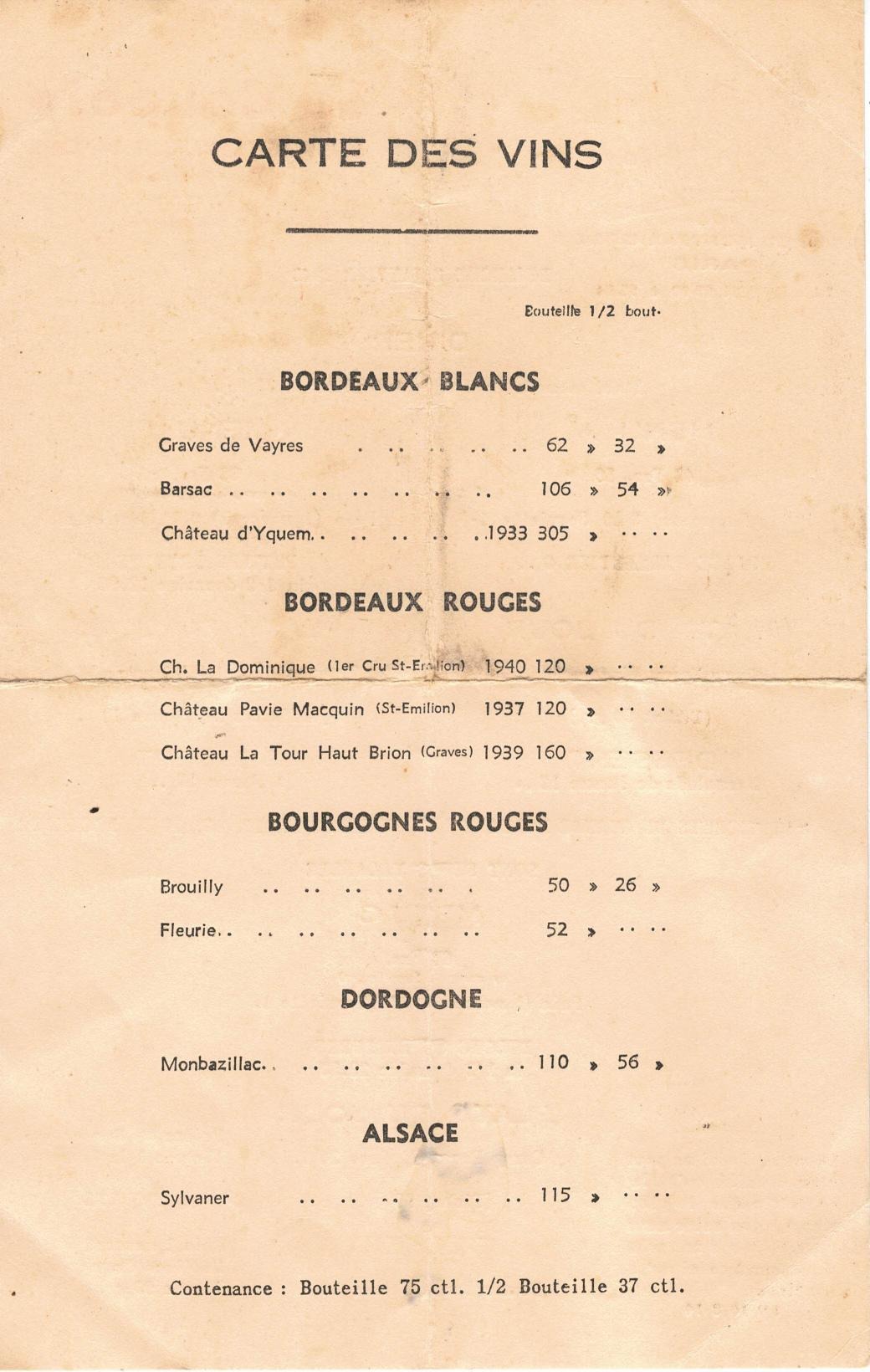
La Carte des Vins
A wine list in Paris is an editorial act. Taillevent's cave holds over 100,000 bottles — a list that reads like an archive of French viticulture. La Tour d'Argent's cellar, rebuilt after the war, holds 300,000 bottles — not a collection but a patrimony. The lesser-known lists matter too: the bistrot that stocks only natural wine from a single vigneron, the brasserie whose carte has not changed in forty years. Each list is a position. Chaque carte dit ce que la maison pense du vin — et par extension, ce qu'elle pense d'elle-même.
Le Pot
The pot lyonnais — 46 centilitres, thick glass, no label — is the most honest way to serve wine in a restaurant. It is not a bottle, not a glass, not a carafe. C'est une mesure. It comes from Lyon but Paris adopted it long ago. The pot says: this wine does not need a name. It needs a table. In the brasseries that still serve en pot, you are drinking not a vintage but a tradition. Le vin de comptoir n'a pas d'appellation. Il a une fonction.
Le Vin Naturel
Paris has become the world capital of natural wine — a movement that arrived in the 11ᵉ and 10ᵉ arrondissements and spread across the city within a decade. The debate is real: purists see it as a return to truth, critics see cloudy bottles and vinegar. What matters for this archive is not the debate but the fact: natural wine has produced the most vibrant cave culture in Paris since the bistrot era. Le Baratin, Le Verre Volé, Septime La Cave — these are not wine bars. They are editorial positions, expressed in liquid.
Le Champagne
Paris is among the largest consumers of Champagne of any city on earth — by some accounts, the largest in absolute volume. The coupe at the bar, the bottle at the table, the magnum for the occasion that does not need an occasion. Champagne in Paris is not a celebration. C'est une ponctuation. It marks the beginning, not the end. You drink Champagne before the meal, not after the toast. This inversion is purely Parisian — and it is the reason that une coupe has its own entry in Rituel.
The Cellar
Beneath the great restaurants of Paris, there are cellars older than the establishments above them. Medieval vaults repurposed for Burgundy. 18th-century caves holding Bordeaux that will outlive the sommelier who placed them there. La Tour d'Argent's cellar was looted during the Occupation — what was hidden behind a false wall survived; what was not, disappeared. The cellar is the only part of a restaurant that improves with neglect — provided the temperature holds and the humidity stays. It is also the only part that carries memory without witnesses. La cave est la mémoire du restaurant. Everything above ground can change — chefs leave, rooms are redecorated, owners sell. Ce qui est en dessous, non.
Heure
Paris does not eat at any hour. It eats at the right one. Le temps à Paris n'est pas une contrainte. C'est une grammaire.
Le Matin
Avant neuf heures. Debout au comptoir. A single espresso, no conversation. Le geste le plus répété de Paris. The city begins here, dans le silence et la caféine.
Le Déjeuner
The only capital where lunch is still a structural act. Not a sandwich. Not a pause. A proper service — bread, wine, time. Paris does not eat at noon. Paris sits down.
L'Apéritif
Entre dix-neuf et vingt-et-une heures, the city changes register. Paris ralentit sans s'arrêter. The glass is not a drink — c'est un seuil. Ce qui suit n'est pas encore décidé.
Le Dîner
Le vrai sujet. The meal for which Paris exists. Everything — the addresses, the cellars, the reservations — leads here. Paris ne dîne pas. Paris donne à dîner.
La Nuit
After midnight. Les brasseries qui ne ferment pas. La soupe à l'oignon, un dernier verre, la compagnie de ceux qui ne dorment pas encore. Paris at night does not eat to nourish. It eats to remain awake.
Rituel
The unwritten rules of the Parisian table. No one teaches them. Everyone knows them. Les règles non écrites de la table parisienne — celles que personne n'explique et que tout le monde applique.
Le Pain sur la Nappe
Not on a plate. On the tablecloth, directly. Pas dans une assiette. No one explains this gesture. Everyone reproduces it. La plus ancienne règle non écrite de la table française.
Le Plateau de Fromages
Avant le dessert. Toujours. L'ordre ne se discute pas. The plateau circulates. On choisit lentement. Paris treats cheese as a course, not as a condiment.
L'Addition
Quelqu'un paie. On ne divise pas. Splitting the check is an importation. Paris résiste. La générosité ici ne se calcule pas. Elle se suppose.
La Coupe
À Paris, on demande une coupe. Pas un verre. The Anglo-Saxon says "a glass of Champagne." The Parisian says une coupe — and everyone understands. Ce n'est pas une question de contenant. C'est une question de langue.
Les Faux Amis
Ask for an americano in Paris and the waiter may bring you the aperitif — Campari, vermouth, soda. Le café allongé existe, mais il ne s'appelle pas comme ça ici. Say scallops and hear escalope — you wanted Saint-Jacques, you'll get veal. Order a macchiato and receive a blank stare. À Paris, c'est un café-noisette.
L'Attente
À La Coupole, on ne réserve pas toujours. On attend au bar. The maître d' hands you a card bearing the name of an artist from the 1920s — Cocteau, Foujita, Man Ray. When your table is ready, it is not your name that is called. C'est celui de l'artiste. Paris has turned the wait into a ritual — and La Coupole into the only restaurant where you are briefly someone else.
La Flamme
La crêpe Suzette n'est pas un dessert. C'est un acte. The pan arrives at the table. The butter, the orange, the Grand Marnier — then the flame. Le geste est précis, silencieux, ancien. The ones that still flambent devant vous are the ones that still believe service is a performance.
Le Café
Le repas se termine par un café. Pas par un dessert. Dessert is optional. Coffee is not. C'est le point final de la phrase. La table est libérée.
Table · 8 maisons
La table parisienne ne se dresse pas. Elle se compose — comme un texte, avec une syntaxe et des silences. Chaque objet posé devant le convive est un mot choisi. Les maisons qui les fabriquent ne sont pas des fournisseurs. Ce sont des auteurs.
Christofle
Paris, since 1830. L'argentier de la République.
Christofle is to the Parisian table what the Haussmann façade is to the Parisian street: the standard that defines the norm. The Ritz, the Plaza Athénée, the Bristol, the George V — the silverware is Christofle. It has been Christofle for a century. Les couverts ne portent pas de marque visible sur la table. Mais le poids, l'équilibre, la courbe du manche — le Parisien les reconnaît au toucher. When Napoleon III commissioned Charles Christofle to furnish the imperial table, he did not merely order cutlery. He established the grammar of French service for all the tables that would follow. The great houses of Paris did not choose Christofle. They absorbed it — the way one absorbs a language in childhood, without knowing there was ever another option.
Puiforcat
Paris, since 1820. Aujourd'hui sous le toit d'Hermès.
Jean Puiforcat redesigned the French table setting as if it were architecture. Where Christofle inherited the ornament of the 19th century, Puiforcat stripped it. The geometric silverware of the 1920s and 1930s — clean planes, calculated weight, the absence of decoration treated as the highest form of it — remains the most radical act of design ever applied to a fork. Il n'a pas simplifié l'argenterie. Il l'a repensée comme un volume. A Puiforcat piece does not sit on the table. It occupies the table — with the quiet authority of an object that knows exactly what it is. The house now belongs to Hermès, which understood that Puiforcat's legacy is not a brand to exploit but a standard to maintain. La rigueur ne se commercialise pas. Elle se perpétue.
Saint-Louis
Lorraine, since 1586. La plus ancienne cristallerie d'Europe.
Before Baccarat, before Bohemia, before Murano turned to crystal — there was Saint-Louis. Four centuries of glass, blown and cut in the Vosges. The house predates Louis XIV. It predates the concept of fine dining. It predates, in fact, most of what Paris considers permanent. Le verre Tommy, créé en 1928, is still produced — unchanged. Ninety-seven years of the same geometry, the same diamond cut, the same weight in the hand. In the world of the table, this is not nostalgia. C'est une preuve de justesse. Saint-Louis now belongs to Hermès. The pairing is logical: two houses for whom time is not a constraint but a material. Ce qui est juste n'a pas besoin d'être remplacé.
Baccarat
Lorraine, since 1764. Le cristal de l'État.
The Harcourt glass was designed in 1841. It has been on every presidential table since. À l'Élysée, on boit dans du Harcourt — and this fact alone tells you everything about the position of Baccarat in the French imagination. It is not luxury. C'est le service de la République. The Cristal Room on Place des États-Unis — the house's Parisian embassy — hangs with chandeliers that weigh more than the arguments of most brands. Baccarat does not perform refinement. It manufactures it, literally: each piece is mouth-blown, hand-cut, and signed. Le cristal ne se fabrique pas à la machine. Il exige le souffle — and the hand that holds the pontil knows that a single tremor separates a masterpiece from scrap.
Bernardaud
Limoges, since 1863. La porcelaine des tables étoilées.
Limoges porcelain is to France what Jingdezhen is to China: the origin. And Bernardaud is its most precise instrument. The assiettes of the great Parisian tables — Alain Ducasse at the Plaza, Le Cinq at the George V, l'Ambroisie — arrive from Limoges. Le kaolin de Saint-Yrieix, extrait à quarante kilomètres de la manufacture, gives the clay its whiteness, its translucency, its capacity to hold a glaze that neither time nor usage can dull. Bernardaud has collaborated with Jeff Koons, with JR, with the architects of the Louvre Pyramid. But these are gestures. The discipline is simpler: une assiette blanche, parfaitement cuite, dont le bord ne s'ébréchera pas. La porcelaine ne se regarde pas. Elle encadre ce qu'on regarde. The plate is the silence around the food.
Hermès
Paris, since 1837. La table comme prolongement du geste.
Hermès did not begin with the table. It began with the horse, the saddle, the hand. But the logic that governs a bridle governs a porcelain cup: the object must serve the gesture without interrupting it. Les porcelaines Hermès — Mosaïque au 24, Balcon du Guadalquivir, Cheval d'Orient — are not tableware. Ce sont des éditions. Each service tells a story drawn from the house's own mythology: the horse, the chain, the architecture of the rue du Faubourg. The difference with other luxury porcelains is one of authorship. Bernardaud makes the plate. Hermès writes what the plate says. With the acquisitions of Puiforcat and Saint-Louis, Hermès now controls the silver, the crystal, and the porcelain — la trilogie complète de la table française. No other house holds all three instruments. Hermès n'a pas constitué une collection. Il a composé un couvert.
Buccellati
Milan, since 1919. L'orfèvrerie comme sculpture.
Buccellati is the only house whose silverware cannot be mistaken for anyone else's. The technique — incisione a bulino, hand-engraving that reproduces the texture of linen, of bark, of lace on the surface of silver — belongs to Buccellati alone. No machine replicates it. No other atelier attempts it. Les couverts Buccellati ne sont pas polis. Ils sont gravés — and the surface holds light the way fabric does, diffusing it rather than reflecting it. Mario Buccellati, the founder, called himself un orfèvre, not a jeweller. The distinction matters. A jeweller adorns the body. An orfèvre furnishes the table, the house, the life. The Milanese workshops still operate by hand, each piece requiring between forty and one hundred hours. À Paris, Buccellati occupe la Place Vendôme — the address that signals, without words, that the house considers itself among the permanent ones. La main n'a pas changé. L'exigence non plus.
Tiffany & Co.
New York, since 1837. Le sterling silver comme position.
Before the diamond, before the blue box, before Audrey Hepburn — Tiffany was a silversmith. The Chrysanthemum pattern (1880), the Audubon pattern (1871), the flatware that furnished the tables of the Gilded Age — this was the foundation. Le sterling silver de Tiffany a défini le standard américain avant que l'Amérique ne sache qu'elle en avait un. The house's relationship to the table is older than its relationship to the ring finger. Edward C. Moore, Tiffany's chief silver designer, won the grand prize at the 1878 Exposition Universelle — in Paris. The French, who had invented orfèvrerie, awarded the prize to an American. Ce n'était pas une concession. C'était une reconnaissance: Tiffany had absorbed the European tradition and returned it with a confidence that Europe found difficult to dispute. Today, the sterling silver collection persists — less visible than the jewellery, less celebrated than the engagement ring, but structurally essential. La table de Tiffany n'est pas un produit dérivé. C'est le premier acte — celui que New York a posé avant de poser tous les autres.
Table is an independent editorial section. No house featured here has commissioned, sponsored, or approved its entry. Les évaluations sont les nôtres. The method is documentation, not promotion.
Géographie
Les Halles
The belly of Paris is gone. The Baltard pavilions were demolished in 1971. What remains is an absence — and a few addresses that remember what was here. Paris n'a jamais remplacé ce qu'il a perdu. Il a simplement construit par-dessus.
Saint-Germain-des-Prés
Le quartier qui a cessé de manger pour penser, puis cessé de penser. What persists does so despite the neighbourhood, not because of it. Le Flore tient. Le reste est parti.
Montparnasse
L'avant-garde mangeait ici — bruyamment, publiquement, dans des brasseries faites pour le bruit. The boulevard has kept its scale. Il a perdu sa raison. La Coupole remains as proof that a room can outlast its era.
Le Marais
Le quartier le plus transformé de Paris en trente ans. L'Ami Louis stands as a fixed point in a neighbourhood that has forgotten stillness. La question est de savoir si l'on peut encore y manger au sens où cette maison l'entend.
La Rive Droite des Palaces
George V, le Bristol, Le Meurice, le Plaza — en un seul kilomètre. The greatest concentration of tables in Paris exists within a triangle of power and discretion. Ce n'est pas un quartier. C'est une position.
Certains lieux ne circulent pas.
They remain.
Certaines relations ne s'affichent pas.
They endure.
Private is not a section.
C'est une frontière.

Eat.Paris exists publicly, but not entirely. Certain addresses, certain conversations, certain continuities belong to a sphere that visibility does not improve. They are neither promoted nor documented. Elles sont maintenues.

This space recognises that discretion is not a lack of information, but a form of respect — for places that operate without exposure, for houses whose value is built over time, and for individuals for whom access is not a request but a condition.

Nothing here is exhaustive.
Nothing here is demonstrative.

Correspondence is received. Not all correspondence is pursued.